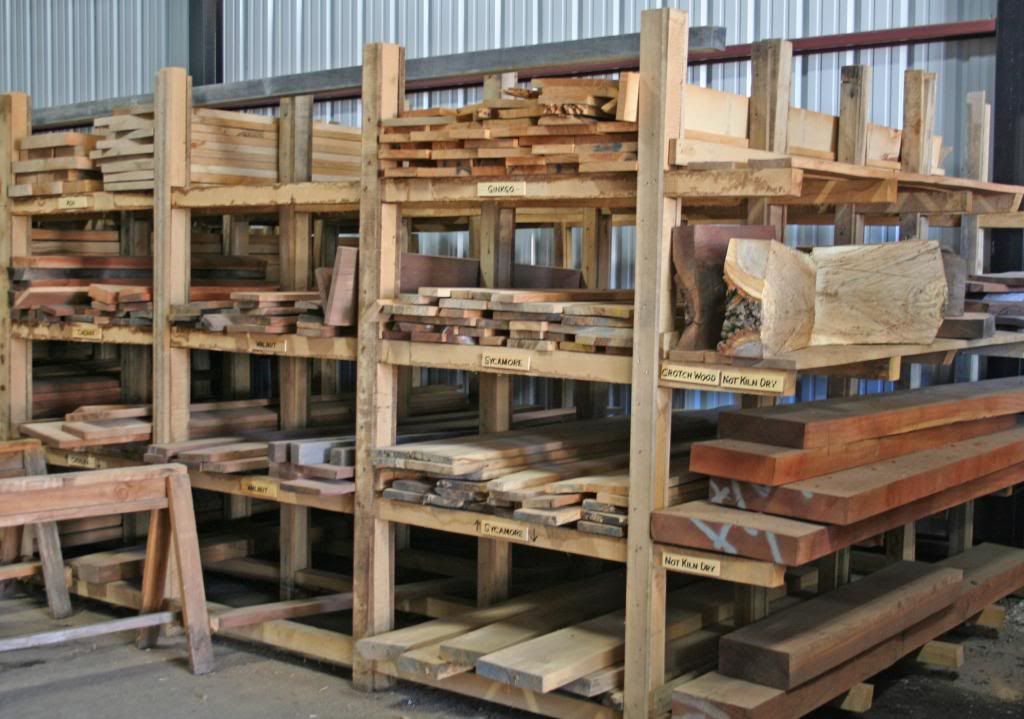
Monday, June 9, 2014

working notes: Tupelo (black gum)

We sawed our first Tupelo log a year or so back. I tend to forget about these things as they air dry, but since it was our first attempt at a species we had not sawn before, I was anxious to run it through the kiln. We quartersawed the log since we figured it was like sweetgum or sycamore: one of those species that moves so much when drying that quartering is the best way to get usable lumber.

I will jump straight to the bottom line: This log has yielded a higher percentage of wood that screams "Keep me!" than any log we've sawn since that curly AND burly soft maple in 2005. I believe the log was lightly spalted - no black line or soft areas, but tons of colors waving in soft flames vertically up the board. Tans, yellows, purples, darker browns, cream, all in undulating striations that really popped with one coat of oil. See for yourself:


Each and every board has these colors throughout the entire board!

I am rearranging my shop schedule to make something out of this wood as soon as possible. Gorgeous wood does that to me. I found a table design I had set aside a while ago; this is the wood for it. I can't wait. The wood is lighter weight than the sweetgum, but it has the same diffuse porous structure that makes the kind of surface that begs to be touched.

Oh, pricing. To be honest I began by pricing this wood like our sweetgum - around $4. (We also just pulled some sweetgum from the kiln, and one of those boards migrated to Tom's Private Stash, along with four for Joe's Stash), but the more I look at it, that is not right. This wood is unique. Other pictures of Tupelo online do not look this spectacular, so the best pieces of this wood will be $8/bf, about what you would pay for normal wood from other places. And this is far from normal. 

First come, first serve.

As far as working characteristics, I may have more to say on this later, but for now it does not appear to be particularly difficult. Naturally it seems much like sweet gum (which may not help you much), although as mentioned these boards are lighter in weight. The sample above shows some tear out from the planer, but it saws, planes, glues and screws just fine. Perhaps soft maple is a comparison that is helpful. When wood looks this good I am willing to tackle some difficulties but I honestly do not foresee any.

*****

October 2015 NOTE: It is possible that the species shown above is sweetgum, not black gum. Sweetgum heartwood, aka "red gum", can have the look shown above. The "tupelo" (black gum) identification is not guaranteed.

Monday, March 17, 2014

working notes: QS cherry

I will not be dwelling here on the working characteristics of cherry. Most of us have experience with it already, and those of you who do not simply must try it; it is (along with walnut) a premier choice for fine woodworking for many reasons. One of those reasons is the way it looks. Its natural color improves over time to a distinctive rich burgundy and its diffuse porous grain begs to be touched. Could it get any better?


Well, yes. Below is the plain sawn (PS) face of cherry, which presents an interesting and beautiful pattern:


But the quartersawn (QS) face of cherry presents a rarely seen side of this gorgeous wood, with smaller medullary ray flecks giving the whole board a subtle yet distinctive sparkle to compliment the slightly undulating annual ring lines.


This is a look that can really elevate a small box or a drawer front. It does not shout from across the room like curly maple or spalted birch, but cherry's color draws the viewer in and when they get closer they see this subtle surprise. It MUST be touched!  Plus of course you get the superior stability that QS wood has over PS cuts.

That's it. Cherry is a spectacular hardwood by any standard, and its QS look is rarely seen and deserves more attention. That is why as soon as we unload our first kiln load in a few weeks we will have a bin of cherry that is exclusively QS material. Ask for it.


Sunday, March 16, 2014

PS, RS, and QS in oak frames and panels

Here is an article I wrote years ago that appears on a couple woodworking forums:

Paying attention to grain patterns with ring porous hardwoods like oak and ash is an important step in a woodworker's maturation and a big part of whether a design succeeds or not. I still have a piece or two I made before I discovered this and frankly, they are hard to look at now. Even though I have since learned to pay attention, I have never seen a systematic review of what different effects were available. So I made three oak frames and three oak panels, stained them to highlight the grain a bit, and interchanged them based upon the grain patterning of how the board was cut from the log. There are nine different combinations. (I was not too exacting with my finishing). 

To review, below you see the three frames, with the quartersawn (QS) one at bottom with its annual rings running vertically in the picture and the medullary rays, which radiate from the pith outward, being horizontal. Where the ray surfaces on the face of the board is what yields the showy figure. In the middle is the riftsawn (RS frame, with both rings and rays on diagonals. The plainsawn (PS) frame on top is more like most boards you buy when you buy oak showing the prominent grain patterning of the annual rings on its face. 


Here are the three combinations all using the PS frame with PS panel first, RS panel next, and the QS panel third: 


In my opinion, none of these are particularly satisfying combinations because the wild uncontrolled grain of the frame is so distracting. And since PS is what you usually get when you buy without paying close attention, this is reason number one to think these things through when you design and when you select boards for a project. 

Next, the RS frame with PS, RS and QS panels: 


Notice how the frame recedes and lets the panel be the focus? If you are going to use a ring porous wood, I'd almost always default to the RS frame for this reason. Note how quiet and unobtrusive the RS/RS one is? I like the effect but it could be considered almost too quiet; the action of the other two panels can be used to quite good effect, keeping in mind what happens with the other parts of the project that aren't frame and panel construction. 

Next, the QS frame with PS, RS and QS panels: 


These aren't subtle, huh? Yet i could imagine finding a way to make the last two work. The PS panel is just an outta control visual, like watching a group of leopards go at it with a family of tigers. The RS panel might be a way to calm down a piece with lots of QS material. Most ww'ers seem to like the boisterous use QS with QS; a few craftsman era pieces depend on it. 

Anyhow, draw your own conclusions. I've sprinkled mine in here and they are only my opinions. What do you think? 

Friday, February 21, 2014

working notes: ginkgo

If you search Woodfinder.com for "ginkgo" or the less correct "gingko" you will not find many vendors. Two, in fact, as I write this. Let's talk about it.


Ginkgo is a softer wood that is a pale buttery color with a tight grain. I recently made some picture frames from both soft maple and ginkgo and the experience was similar with each. Ginkgo might be a bit softer, it does not tear out nearly as much in the planer (but it will tear out if you go dead against the grain), but in most ways it works like a soft maple. Its looks would be more easily confused with a white pine. One notable point is that there do not seem to be any bad boards; all knots including the pith are tight and will stay in place. It is easy to hand plane, glue and screw into. Like soft maple, being on the soft side of many of the woods we work is an advantage to a project like a picture frame where you are gluing up miters. (Miters with softer wood go together faster and with less fuss, at least in my shop).

Maple on the left, ginkgo on the right. Both are unfinished:


Michael Bauermeister, an experienced woodcarver, offered me these comments on working ginkgo: "Ginkgo is a nice carving wood that can be worked with hand tools. While not as easy to carve as basswood, it does cut cleanly and holds a nice, crisp edge. It is similar to butternut in terms of carving and grain but lighter in color."


I have not turned any ginkgo, but I imagine that those characteristics mentioned would make a nice looking bowl if you can finds chunks to work with. We sell 4/4 and 8/4 boards. I could see it used as a secondary wood in place of maple or poplar if you wanted something with a slightly different look. Its color is much more consistent than either maple or poplar, at least in the logs we have sawn. Because of this consistency, we chose it for the signs on our lumber racks.


The tree can grow fairly large and magnificent, and it remains much as it was when the dinosaurs roamed. Not many species have been around as long. We see very few logs which might help explain why such a fine wood is not seen commercially. Like poplar or maple or butternut, it probably does not offer much rot resistance so it should be used indoors, but it is such a pleasure to work that I keep trying to think of more uses there.

Our ginkgo sample:

Monday, September 9, 2013

Bye bye butternut

Since we began this effort in 2004 we have come across exactly ONE butternut log. Apparently it does not grow naturally around here; thanks to whoever planted the one way back when. We had it sawn and just now sold the last of the lumber.

My only point - and you already knew this - is that if and when you come across some special wood, hoard it. Many of us already do this but I am surprised how many have spare bedrooms that are NOT filled with lumber. Kidding. Sorta.

Tuesday, September 3, 2013

Live edge material

We have always tried to have a few pieces of live edge material available - I rarely see this kind of stuff around town - and recent response has encouraged us to saw even more. I thought I'd show you what we now have in larger unique pieces.

These are longer walnut pieces with some curve to them. I could see two of them book matched and straight line joined for table top, or perhaps a set of shelves with a natural bow front. The water stains plane off. The narrow one in front is one of the first slabs; they get wider towards the center of the log.

[photo missing]

Here are some cherry pieces, some with crotch figure at the end:

[photo missing]

These walnuts have some straight edges simply because they were too wide to fit on the saw without trimming. That figure at the end will finish up nicely. Ash on the right.

[photo missing]

We have a number of cherry pieces air drying, some fairly short and a log's worth of longer pieces that will take a while yet to dry but I expect to be worth the wait: crotchy with bark on both edges if I recall correctly.

Don't forget our smaller crotch pieces. These are what I would reach for if I wanted to resaw my own figured panels for a frame and panel piece. Below them are some mantle pieces in cherry and walnut. None of these are kiln dried.


We may have located a new sawyer and this is an area we will building up over time, so stay tuned.

Monday, June 3, 2013

News update

We are well into solar kiln season; we just pulled our second load out this past weekend. It was nearly all 5/4 and 6/4 white oak for those craftsman era projects that want 1" + thick finished wood. Lots of quartersawn and riftsawn white oak in different thicknesses is now available in the sale bins.

Recent visitors may have noticed that we are beefing up our inventory of natural edge slabs. We now have thick pieces of cherry, walnut, ash, butternut, and maybe one or two more species for table tops of unique character. We also have some large half log crotches that we could saw a piece off of for you:


I am now making a bench/table using one of these walnut crotch pieces and it is a very rewarding milestone to reach in one's woodworking career. Since the piece is over 36" wide the tool of choice for flattening the slab (short of taking it to a commercial place like Crescent Planing Mill or Fehlig Brothers*) is a hand held power planer. This is my first time using one and it is a real time saver. Final finishing still belongs with hand planes and sandpaper. There are photos of this finished piece and many others of our wood on the Gallery 2013 page.


* A customer of ours recently took two large natural edge cherry slabs to Fehlig and got them both planed for something like $25. He noticed the problem with this bargain later in the shop: the wood was surfaced alright but NOT JOINTED. The boards did not sit flat on the base. Wrestling this kind of material certainly presents challenges!

One other news item: our sawyer sold his saw. John had been sawing our lumber for the past few years and we will certainly miss his quarter sawing ability. He was clearly the best we have ever had at getting a large percentage of beautiful QS material from a log. If you have ever looked around town at what passes for QS white oak and compared it to our QSWO bin, you know what I mean. Meanwhile, if you know of any local sawyer who is looking for some regular work, please shoot me an email at lumberlogsllc AT g mail DOT com.