Friday, February 21, 2014

working notes: ginkgo

If you search Woodfinder.com for "ginkgo" or the less correct "gingko" you will not find many vendors. Two, in fact, as I write this. Let's talk about it.


Ginkgo is a softer wood that is a pale buttery color with a tight grain. I recently made some picture frames from both soft maple and ginkgo and the experience was similar with each. Ginkgo might be a bit softer, it does not tear out nearly as much in the planer (but it will tear out if you go dead against the grain), but in most ways it works like a soft maple. Its looks would be more easily confused with a white pine. One notable point is that there do not seem to be any bad boards; all knots including the pith are tight and will stay in place. It is easy to hand plane, glue and screw into. Like soft maple, being on the soft side of many of the woods we work is an advantage to a project like a picture frame where you are gluing up miters. (Miters with softer wood go together faster and with less fuss, at least in my shop).

Maple on the left, ginkgo on the right. Both are unfinished:


Michael Bauermeister, an experienced woodcarver, offered me these comments on working ginkgo: "Ginkgo is a nice carving wood that can be worked with hand tools. While not as easy to carve as basswood, it does cut cleanly and holds a nice, crisp edge. It is similar to butternut in terms of carving and grain but lighter in color."


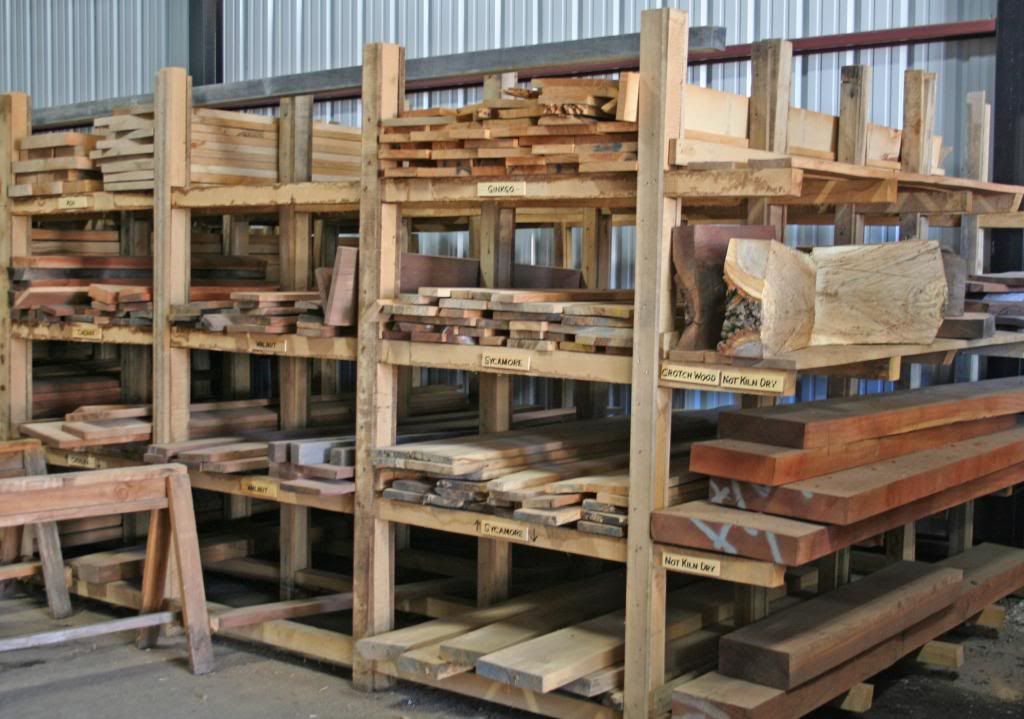
I have not turned any ginkgo, but I imagine that those characteristics mentioned would make a nice looking bowl if you can finds chunks to work with. We sell 4/4 and 8/4 boards. I could see it used as a secondary wood in place of maple or poplar if you wanted something with a slightly different look. Its color is much more consistent than either maple or poplar, at least in the logs we have sawn. Because of this consistency, we chose it for the signs on our lumber racks.


The tree can grow fairly large and magnificent, and it remains much as it was when the dinosaurs roamed. Not many species have been around as long. We see very few logs which might help explain why such a fine wood is not seen commercially. Like poplar or maple or butternut, it probably does not offer much rot resistance so it should be used indoors, but it is such a pleasure to work that I keep trying to think of more uses there.

Our ginkgo sample:

Monday, September 9, 2013

Bye bye butternut

Since we began this effort in 2004 we have come across exactly ONE butternut log. Apparently it does not grow naturally around here; thanks to whoever planted the one way back when. We had it sawn and just now sold the last of the lumber.

My only point - and you already knew this - is that if and when you come across some special wood, hoard it. Many of us already do this but I am surprised how many have spare bedrooms that are NOT filled with lumber. Kidding. Sorta.

Tuesday, September 3, 2013

Live edge material

We have always tried to have a few pieces of live edge material available - I rarely see this kind of stuff around town - and recent response has encouraged us to saw even more. I thought I'd show you what we now have in larger unique pieces.

These are longer walnut pieces with some curve to them. I could see two of them book matched and straight line joined for table top, or perhaps a set of shelves with a natural bow front. The water stains plane off. The narrow one in front is one of the first slabs; they get wider towards the center of the log.

[photo missing]

Here are some cherry pieces, some with crotch figure at the end:

[photo missing]

These walnuts have some straight edges simply because they were too wide to fit on the saw without trimming. That figure at the end will finish up nicely. Ash on the right.

[photo missing]

We have a number of cherry pieces air drying, some fairly short and a log's worth of longer pieces that will take a while yet to dry but I expect to be worth the wait: crotchy with bark on both edges if I recall correctly.

Don't forget our smaller crotch pieces. These are what I would reach for if I wanted to resaw my own figured panels for a frame and panel piece. Below them are some mantle pieces in cherry and walnut. None of these are kiln dried.


We may have located a new sawyer and this is an area we will building up over time, so stay tuned.

Monday, June 3, 2013

News update

We are well into solar kiln season; we just pulled our second load out this past weekend. It was nearly all 5/4 and 6/4 white oak for those craftsman era projects that want 1" + thick finished wood. Lots of quartersawn and riftsawn white oak in different thicknesses is now available in the sale bins.

Recent visitors may have noticed that we are beefing up our inventory of natural edge slabs. We now have thick pieces of cherry, walnut, ash, butternut, and maybe one or two more species for table tops of unique character. We also have some large half log crotches that we could saw a piece off of for you:


I am now making a bench/table using one of these walnut crotch pieces and it is a very rewarding milestone to reach in one's woodworking career. Since the piece is over 36" wide the tool of choice for flattening the slab (short of taking it to a commercial place like Crescent Planing Mill or Fehlig Brothers*) is a hand held power planer. This is my first time using one and it is a real time saver. Final finishing still belongs with hand planes and sandpaper. There are photos of this finished piece and many others of our wood on the Gallery 2013 page.


* A customer of ours recently took two large natural edge cherry slabs to Fehlig and got them both planed for something like $25. He noticed the problem with this bargain later in the shop: the wood was surfaced alright but NOT JOINTED. The boards did not sit flat on the base. Wrestling this kind of material certainly presents challenges!

One other news item: our sawyer sold his saw. John had been sawing our lumber for the past few years and we will certainly miss his quarter sawing ability. He was clearly the best we have ever had at getting a large percentage of beautiful QS material from a log. If you have ever looked around town at what passes for QS white oak and compared it to our QSWO bin, you know what I mean. Meanwhile, if you know of any local sawyer who is looking for some regular work, please shoot me an email at lumberlogsllc AT g mail DOT com.


Tuesday, February 5, 2013

still sawing

In the sort of progress that is hard to notice unless you look very carefully, we continue to fill up the air drying section of our inventory. We just stacked some nice wide walnut and some spalted sycamore plus some honeylocust boards that would make a spectacular table top:


 Here's hoping we get many warm sunny days this summer for running wood through the kiln. With the larger capacity racks in the building, it should be even more difficult to not find what you want as we fill them up.

We have been sawing a number of thick mantle pieces too, from walnut, cherry and oak. These pieces will not be kiln dried and should offer the kind of character that a nice mantle piece needs.

The band saw is out for repair. It has never been quite right and needed a larger motor for the wide band. Once it returns, we ought to be able to trim and stack some wood that got set aside when we moved. In short, between the sawing and the ability to trim, I am excited about our lumber inventory for the coming year!


Thursday, November 29, 2012

collecting customer information

I just had an experience at Walgreens that disturbed me. I bought two items for $4.32 that would have cost me $7.52 if I had not signed up for their member program. This included giving them personal information like address and phone number so they can track every purchase I ever make in the future at any Walgreens. I realize that governments and retailers are collecting and storing all sorts of personal information "to serve us better", but really now, do I need anything more than inventory in place when I want an extension cord?

I will pass on the extended rant - I doubt it would change the world - but I want you to know one thing: Lumber Logs will NOT be asking for your social security number, income tax bracket, or if you have any outstanding parking tickets when you buy lumber from us. The only questions we do ask are things like "what are you building?" or "have you tried persimmon for that use?" - you know, things that are relevant to getting what you really want. Plus, we will charge you the same price per board foot whether you buy 3' or 300'.

This isn't just because I think "1984" is one of the scariest books ever written. It's also because loading your mailbox with coupons for extension cords does not strike me as useful to either of us. Plus, if you have met either Joe or Tom, it may not surprise you that neither is the sort to keep track of this kind of detail. Heck, I once had email addresses for hundreds of lumber buyers but effectively lost them in the email hack episode a while back. It's nice when following the Golden Rule is easier.

*****

Timber frame update: no news really. We cut some 6x6 white oak and have it air drying a bit before we work it into the log rack. Perhaps this winter will see some progress, but if it proceeds like this blog, don't hold your breath!

Sunday, August 12, 2012

Timber frame log rack

Up to now, Joe has scanned logs for metal primarily on our lot. There might be a preliminary scan at pickup if conditions allow, but the full thorough scan happens in our yard. Since the scanner picks up metal in the parking surface, he piles logs up high and and walks on the piles to scan them. This is not the safest thing he does every day because log piles can and do shift around at times. It is time to improve the method.

We need a platform to rest large logs on that is 5' above the lot surface. The rack cannot have any metal in it, so this is the chance to build something sort of timber framey I have been hankering for. Nothing fancy beyond large pinned mortise and tenons will be needed, but working with 6x6 fresh cut white oak should offer some interesting challenges. The rack will be 16' wide and 8' long. There will be three 16' sections to build and then join together. Joe has the cut list (which I have not seen yet) and just picked up some 16' long 6x6s. I spent today turning some 7" long 7/8" black locust dowels for pinning the joints.

This should be a fun and interesting project and we will follow it right here.

EDIT: This never happens.